In the 21st century, tarot has become incredibly mainstream, popular and trendy.
In the 1980s and 1990s, tarot decks were exclusively found mostly in brick-and-mortar new age shops (if you were lucky to have one in your city or town) and select bookshops would carry a few tarot decks, which the occult/new age section was often small and minimal unlike today.
The old myth that someone had to be “gifted” a tarot deck was known by anyone who had heard of tarot, that the myth was still believed by many in the early 21st century.
However, as tarot has become popularized, mainstream on social media, online shops all around the world, tarot decks are readily available and are often quite affordable depending on what you’re looking for (although indie tarot decks will tend to be more expensive than mass marketed tarot decks.)
Then, there’s traditional playing cards which aren’t as popular or common as tarot – but are “the old school” before-there-was-a-school kind of reading that was traditionally passed down through generations (tarot was too, but is now mainstream.)
For example, the hashtag #tarot on Instagram has 21.8 million posts and the hashtag #tarotcards on the same platform has 6.4 million posts.
Meanwhile, the hashtag #playingcardreading on Instagram has just over 1000+ posts as well as #playingcarddivination has just over 1000+ posts also.
(BTW, you want to see our playing card readings on Instagram follow those two (2) playing card hashtags and follow us on Instagram too.)
In this post we’ll explore:
• A Brief History of Tarot
• A Brief History of Playing Cards
• Difference between Tarot and Playing Card Readings
• Basic Overview of Tarot and Playing Cards
• Differences in Interpretation of the Cards
• What to Ask Tarot or Playing Cards (compared to oracle cards, dominoes and Lenormand)
• Where to get a Playing Card Reading
You’ve likely have had played with and/or owned a playing card deck while growing up. Many households gave at least one deck of playing cards stashed away somewhere, whether the deck was gifted, purchased or came free with a purchase.
Every kid has at least played games like “Go Fish!” or “War” and then there’s the annoying game, “52 Pick Up”.

Playing Cards have been used by many folks to pass the time or at casinos, playing Blackjack or Poker. Even my childhood in the summer was spent with my mum and her sisters as we played Rummoli with each of us having a bucket full of pennies for our “bets”.
Playing cards may not seem to have any occult connection as in the way that tarot is automatically assumed to have a spiritual or mystical association.
While tarot may sometimes be “demonized” by some people, the same people may be shocked to know that a simple deck of playing cards that are often used for games can hold as much ability to foretell the future as cards with images on them.
A Brief History of Tarot
Historians say that Tarot can be traced back to the 15th century in regions of Italy as a card game known as Tarocchi and as other similar names.
By the late 18th century, the story about the meaning and around the origins of these cards began to have a more mysterious and occult interpretation in France.

As the years progressed, more people have put study and personal interpretation into Tarot as if the layers of the onion are peeled away.
This onion has outer layers and inner layers both as we examine our outer and inner worlds.
From these new interpretations of Tarot have become a foundation for what people currently associate tarot to be now as much more than its card game initial beginnings.
Here’s a brief look at some history of tarot and historical tarot decks.
A Brief History of Playing Cards
It’s said that playing cards originated in China and were brought to Europe in the 14th century indirectly from China by the Islamic Mameluke (Mamlūk) dynasty centered in Egypt.
As the same with Tarot cards, the first original playing cards were hand-painted which made acquiring a deck somewhat only for the wealthy or folks with money to spare on luxuries.
For more information about the history of playing cards, read this detailed article from Playing Card Decks.
What’s the Difference between Tarot and Playing Card Readings?
While it may seen obvious the difference between what a tarot deck and a playing card deck is, how these are used for divination / fortune telling can be vastly different.
In simple terms, tarot may be able to do what playing cards can do but playing cards can’t do exactly what tarot can do for readings.
Basic overview
Tarot uses usually 78 cards, although some decks like Pug Tarot have 80 cards. Read our review about Pug Tarot.
Differences in Interpretations of the Cards
Playing card decks traditionally have 52 cards, however, only 36 cards are used for most readings.
Tarot tends to have standard or universal meanings of the major and minor arcana cards.
While some of these interpretation in tarot may vary slightly, the basis of the cards remain the same.
Playing Card interpretations vary depending on the style or region.
For example, there interpretations based on styles found in France, Germany and Hungary.
In a Western perspective, the minor arcana may sometimes be associated with the suits of playing cards: Hearts = Cups, Clubs = Wands, Diamonds = Pentacles, Swords = Spades.
Playing card readings are popular in Eastern Europe, and also the Carpathians, in which each reader would have their own style and possibly interpretations.
For example, it’s more common to get a playing card reading from a vorozhka (Ukrainian: ворожка = fortune teller) in the Carpathians than to get a tarot reading in some regions due to availability and traditions.
Playing cards are readily available in every region and country; no one needs to shop at an expensive new age store to get their hands on a playing card deck.

What do You ask Tarot or Playing Cards?
When it comes to different forms of divination, not all divination forms will be suitable for all questions.
Here are a few examples:
Oracle Cards
Oracle cards were very popular and many people still use them today. However, oracle cards can be limited based on the design of the cards and each oracle deck is different rather than universal such as tarot.
If using an oracle deck, there may be certain questions that it can’t answer – so it’s always good to familiarize with each oracle deck.
Certain oracle decks won’t be able to answer specific questions as the design of the deck may be limited rather than universal such as tarot.
Most oracle decks have fewer cards (usually around 40 cards) than a standard tarot deck (which has 78 cards.)
Lenormand
The same is for if working with Lenormand cards.
Lenormand is somewhat a cousin of playing cards as many Lenormand decks also include the traditional playing card image on the cards in addition to the traditional Lenormand images such as the Fox card, the Letter card or the Key card.
Lenormand can be read in a very analytical approach, somewhat mathematical and orderly by some people and for others can be intuitive or a combination of both.
This system of cards can be interpreted in a practical and realistic regarding day-to-day situations and events, especially about the present and future.
Tarot
Tarot is the most common and now well-known divination system with millions of posts on social media, on blogs and articles, and books that are more readily available on the market.
Tarot is considered a combination of spiritual, intuitive, psychic, analytical, self-exploration, and yes, can even be for fortune telling.
Tarot can provide answers that are spiritual or practical in nature.
In a tarot reading, you can ask about relationships, sex, money, work, business, pets, feelings, emotions, what choices or decisions to make, what’s going on in a situation, what happened and why, what will happen and why, and what to do about it.
Tarot can be used for spirit communication, meditation, tarot spell work or tarot magic.
Tarot is versatile, that no two tarot readers will read a card or tarot reading exactly the same way.

Dominoes
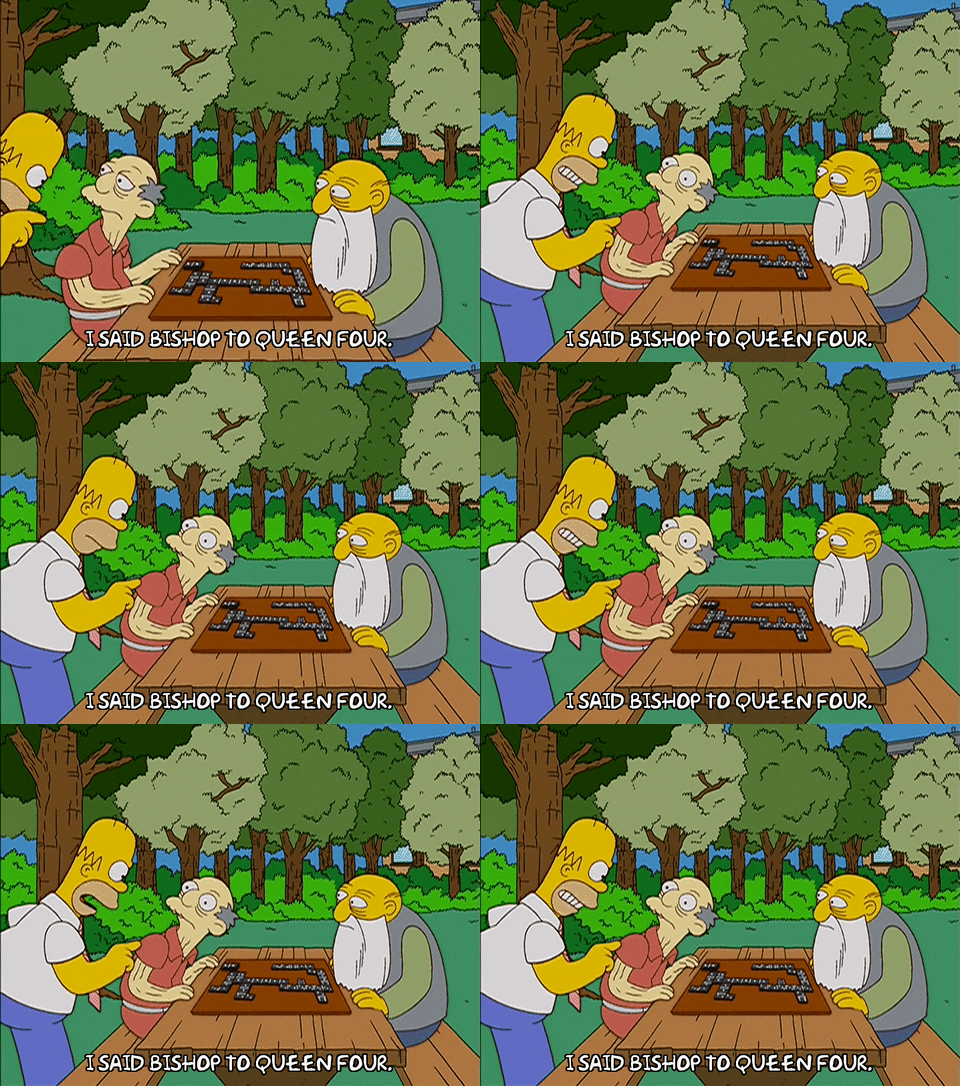
Another divination tool is dominoes which is similar to tarot in that the dominoes can be used for predictive readings as well ass introspective readings.
Just like playing cards, dominoes is commonly used as a game for children and adults alike but can also be used for divination.
Dominoes can be read in a similar fashion as tarot, with spreads and different interpretations as well as using numerology.
Try a domino reading from the shop to see for yourself.
Playing Cards
Playing cards for divination are simple, straightforward and less “beat around the bush” than tarot can be in some instances.
People may have difficulty finding the message in a tarot reading, which when that happens (such as any divination reading), it may be best to simply pick one aspect of the reading and build upon that.
In a playing card reading, the interpretation meanings for each card are shorter and simpler than tarot.
While tarot meanings for each of the 78 cards may be at least one page long (that is, minus key words only), playing card meanings can be simple with only a few key words for each card.
Playing cards just like Lenormand readings are easily built by creating one or two sentences to express the meaning, meanwhile tarot can be a whole thought stream as images and intuition are channeled or attempted to be interpreted into words.
Readings done with playing cards can be excellent for predictive readings, however are often not intended for introspective or spiritual readings.
So what to ask the playing cards?
An open mind and being receptive to whatever the playing cards may tell you is best when receiving or performing a playing card reading.
The easiest questions to ask playing cards that get the most benefit are:
• What do I need to know now?
• What will happen today / tomorrow / this week / next week / this month?
However, the best is to simple let the playing cards tell you what they want you to know.
Playing cards are often read in a “fortune telling” style that they tell your “fortune” – straight and simple, often easy to remember because of the fewer words and often are direct.

Curious to have your reading?
Request a playing card reading in the shop.


Images designed in Canva
 TarotPugs